There are two common views in the market:
- Hub motors are simpler in structure and lower in cost
- mid-drive motors offer higher performance and belong to higher-end products
While these statements capture certain characteristics, they are far from sufficient to guide actual bike design and component selection.
Hub motors and mid-drive motors are not simply a matter of low-end versus high-end; they represent two fundamentally different drivetrain architectures. Which one to choose depends primarily on the bike type, target use case, and the specific problems the overall bike design aims to solve.
1. The difference is more than just where the motor is mounted
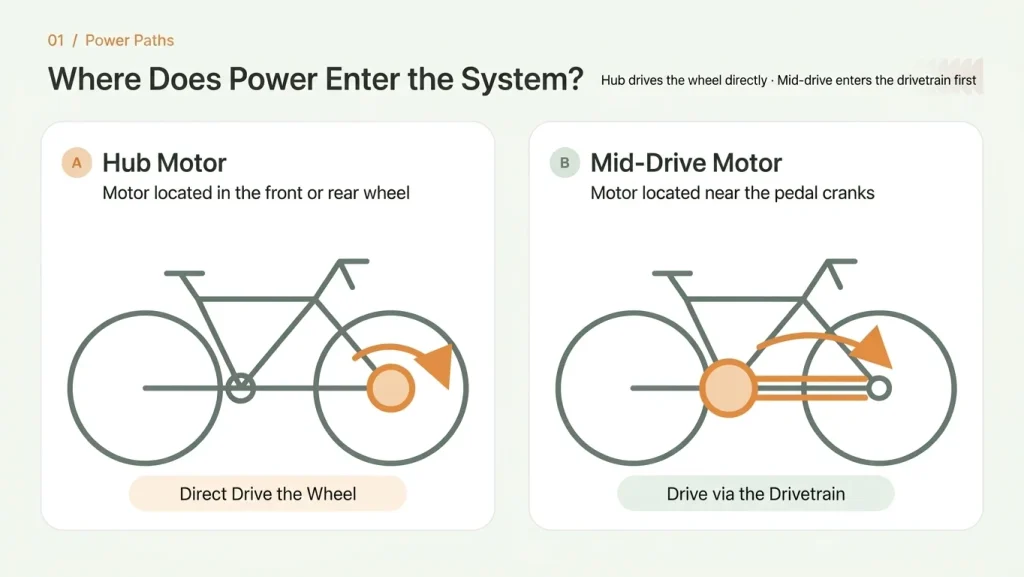
Hub motors are mounted in the front or rear wheel hub, driving the wheel directly. Mid-drive motors, on the other hand, are typically positioned near the pedal cranks—commonly referred to in the industry as the bottom bracket area—where power is transmitted to the wheel through the chain or belt drive system.
To put it simply: hub motors drive the wheel directly, whereas mid-drive motors send power through the bike’s drivetrain first before reaching the wheel.
While it seems like a mere difference in mounting location, it actually cascades into every aspect of the bike:
- How power is transferred to the wheels
- How overall bike weight is distributed
- How the frame, wheelsets, and drivetrain must be engineered
- How straightforward mass production, software tuning, and long-term maintenance will be
Therefore, once the motor architecture is decided, it is no longer just a matter of swapping out a component—it fundamentally defines the primary product development pathway for the entire bike.
2. Hub motors are not synonymous with “low-end solutions”
A key characteristic of hub motors is that power can act on the wheel relatively independently, without having to pass entirely through the bike’s original chain and transmission system.
Because of this, they are commonly found in short-distance city commuters, folding bikes, small-wheel bikes, as well as on road and Gravel e-bike models where lightweight design and clean, simple aesthetics are prioritized.
For projects aimed at reusing existing platforms, shortening development cycles, and controlling overall bike costs, hub motor solutions are also much easier to introduce during initial evaluation.
However, a “relatively straightforward architecture” does not mean the riding experience is necessarily simple.
The performance of a hub motor system still depends on its sensors, controller, algorithms, wheel size, total bike weight, and power response tuning.
Without accurate pedal input sensing and responsive power delivery, a motor alone can rarely deliver a natural riding experience.
Conversely, when properly integrated and tuned, hub motor solutions can just as effectively power products that emphasize lightweight design, quiet operation, high integration, and natural-feeling pedal assistance.
Front and rear hub motors are not interchangeable choices, either.
Front hub motors have minimal impact on the rear drivetrain, but they require critical validation of front-wheel traction, steering feel, front fork dropouts, and overall weight distribution.
Rear hub motors generally deliver a ride feel that aligns more closely with traditional rear-wheel drive dynamics; however, they occupy critical rear axle space and directly impact the cassette, braking setup, spokes, wheel assembly/disassembly, and overall after-sales maintenance.
Therefore, even if a hub motor architecture has already been selected, deciding between a front or rear placement still requires returning to the overall vehicle frame structure and intended usage scenarios.
3. Mid-drive motors are not simply “better as long as you install one”
Mid-drive motors output power directly through the bicycle’s drivetrain, allowing them to leverage the rear gearing system to adjust drive ratios.
Under steep climbs, heavy loads, and complex road conditions, proper gear shifting allows the system to better balance speed, cadence, and power demand. Consequently, mid-drive solutions are commonly found in:
- Long-distance touring (Trekking) and extended commuter bikes;
- E-MTBs (electric mountain bikes) and other complex-terrain models;
- Cargo e-bikes, passenger-carrying models, and heavy-payload vehicles;
- Products with higher demands for hill climbing, agile handling, and sustained power output;
- Platform-level products that require deep integration across frame engineering, drivetrain mechanics, and software user experience.
A mid-drive layout generally excels at concentrating weight near the center of mass, but it also introduces a new set of system requirements:
First, because power is transmitted through the chain, belt, cassette, or internal gear hub, the loads and wear rates on all drivetrain components must be re-evaluated.
Second, the frame interface, mounting envelope, ground clearance, impact protection, cable routing, and final assembly processes must all be cross-functionally alignment and validated early in the development cycle.
Third, the real-world riding experience of a mid-drive system is deeply tied to gear-shifting habits, cadence ranges, and software tuning parameters.
Selecting a mid-drive motor does not automatically guarantee superior overall efficiency or a better riding experience.
The advantages of a mid-drive motor can only be fully realized through the joint synergy of frame geometry, drivetrain components, control algorithms, and proper rider operation.
4. Six Questions to Answer Before Finalizing Motor Selection
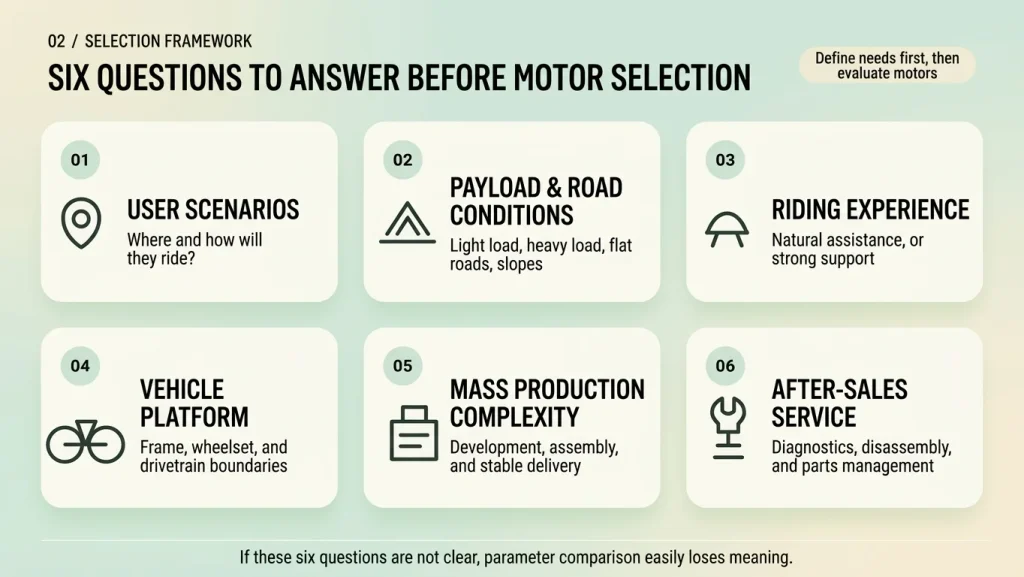
Rather than asking "hub or mid-drive" right out of the gate, it is better to first clearly define the following six questions.
1. Where and how will the user ride?
Is it for short urban commutes, weekend leisure, or long-distance daily riding? Is it primarily flat paved roads, or frequent steep climbs and complex terrain? The intended usage scenario dictates what the bike truly requires—not just peak power output, but low-speed responsiveness, sustained performance, energy efficiency, acoustic noise levels, and overall handling.
2. How much total payload must the bike accommodate?
The demands placed on the powertrain vary drastically across single-rider light loads, passenger transport, cargo delivery, and high-frequency commercial operation.
Higher payloads, steeper gradients, and longer continuous operating cycles put greater emphasis on thermal management, drivetrain fatigue loading, and real-world sustained performance.
3. What riding feel is the product intended to deliver?
Some bicycle models aim for subtle power delivery that closely mimics a traditional bicycle, while others emphasize immediate off-the-line support, climbing capability, and pronounced motor assistance. Even with the exact same motor architecture, differing sensor configurations and control strategies will yield entirely distinct riding dynamics.
4. What structural modifications do the existing frame and drivetrain platforms allow?
If you intend to carry over a mature platform, a hub motor scheme is often much easier to evaluate; however, if you are willing to redefine the frame, drivetrain, and cable routing around the powertrain, a mid-drive system typically offers far greater integration potential.
That said, engineering teams must still rigorously cross-check mounting interfaces, wheel size, braking components, cassettes or belt drives, chainlines, structural integrity, and total packaging constraints—rather than simply asking if the motor can “physically fit.”
5. How much development and mass-production complexity can the project absorb?
Motor selection cannot be judged on prototype performance alone; it must also account for development timelines, tooling investment, assembly processes, supply stability, and end-of-line consistency verification.
A solution that offers superior performance on paper—yet fails to achieve stable mass production or meet delivery schedules—is not necessarily of greater value to the project.
6. Who will handle after-sales service, and how will it be executed?
Hub motor schemes require careful consideration of wheel removal and installation, wiring harness interfaces, and spare parts logistics. Mid-drive schemes, on the other hand, demand simultaneous management of the motor, drivetrain components, diagnostic tools, and field service capabilities.
Different distribution channels and after-sales networks vary significantly in the level of system complexity they can support. If this factor is overlooked during component selection, service issues will inevitably surface en masse once the product hits the market.
5. How to make a preliminary assessment for different bike models?
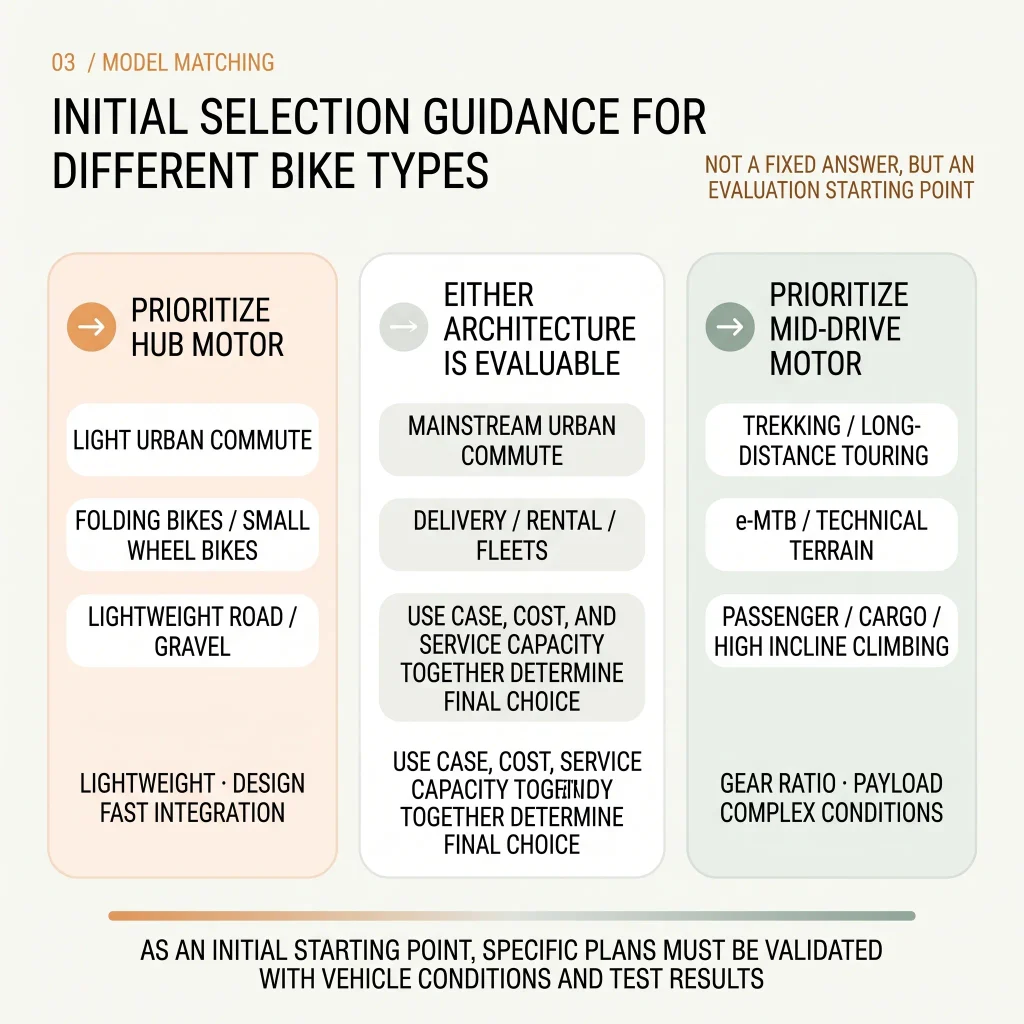
Before diving into specific parameters and project verification, four directional assessments can be established first.
1. Lightweight city commuters, folding bikes, and road models
If the roads are relatively flat and the product prioritizes lightweight design, aesthetics, cost efficiency, and quick integration, front or rear hub motor solutions can usually be evaluated first. For lightweight road and gravel models, key focus should also be placed on wheelsets, sensor integration, and natural power response.
2. Mainstream city commuter and comfort models
These models can use either hub motors or mid-drive motors. The actual basis for judgment depends on slope gradient, load capacity, riding range, maintenance methods, target retail price, and the riding experience the brand intends to deliver.
3. Long-distance touring, mountain, and cargo/passenger models
When dealing with complex road conditions, steep gradients, or scenarios that require full utilization of the bike’s drivetrain, mid-drive motors are usually worth prioritizing for evaluation. However, beyond the motor itself, braking systems, frames, wheelsets, drivetrains, and thermal management must also be verified simultaneously.
4. Delivery, rental, and fleet operation models
For these types of products, performance cannot be evaluated solely at the individual bike level. Operating hours, failure rates, maintenance efficiency, spare parts costs, and vehicle downtime are often more critical than any single performance spec. Both hub motor and mid-drive solutions can be viable; the ultimate comparison comes down to the total cost of ownership across procurement, daily operation, and maintenance downtime. The points above serve only as a starting framework for powertrain selection, not absolute rules. Even within the same category—such as ‘city bike’ or ‘cargo bike’—the drive architecture can vary completely depending on the market, target user, and operational model.
6. Three of the most common pitfalls in model selection
1. Comparing only nominal torque
Hub and mid-drive motors deliver power at different points, with mid-drive systems further affected by the bike’s gear ratios.
The actual power delivered to the wheels is influenced by reduction gearing, wheel diameter, selected gear, total vehicle load, and control strategies.
Therefore, nominal torque across different drive architectures cannot be directly compared without accounting for measurement points and complete bike parameters.
2. Directly determining motor architecture based solely on product price
Hub motors do not inherently mean low-end, nor do mid-drives automatically mean high-end.
What truly sets products apart are system integration, riding experience, reliability, service capability, and whether the bike accurately solves the target user’s problem.
3. Treating a “rideable sample bike” as a “validated project”
The prototype stage only validates that the concept works; a mass-production project must further verify structural integrity, thermal management, durability, waterproofing, EMC (electromagnetic compatibility), assembly consistency, software versions, and post-sales support closure.
From the initial road test to stable mass delivery, there is still an entire system engineering process in between.
7. What companies truly need to select is a matched system relationship
For brands and OEMs, model selection should start with the target user and product definition, rather than starting with a motor specification sheet.
For system and component suppliers, value should not stop at “providing a motor,” but in helping customers assess whether the mechanical, electrical, software, drivetrain, and service elements form a complete closed loop.
For channels and service providers, diagnostic, spare parts, and assembly/disassembly capabilities must be considered in advance to avoid leaving unaddressed front-end issues to post-sales support.
Therefore, there is no absolute answer to hub motors versus mid-drive motors when separated from the specific application scenario.
Good model selection isn’t about picking a motor with higher specs, but rather aligning the powertrain architecture with user scenarios, vehicle platforms, mass-production capabilities, and post-sales responsibilities.
When all of these elements align seamlessly, only then is the powertrain solution truly fit for the vehicle.
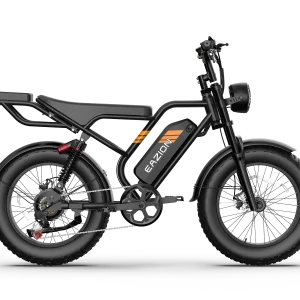
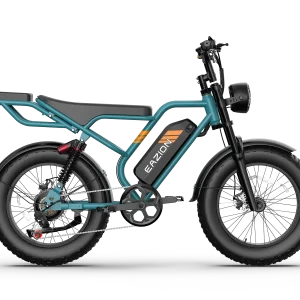
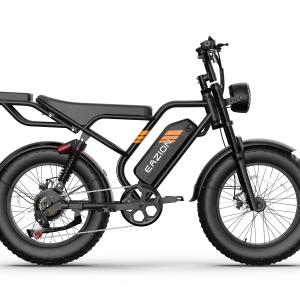
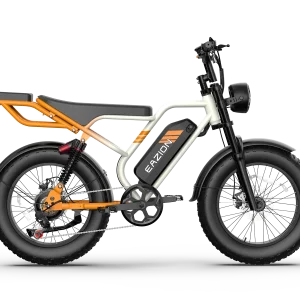
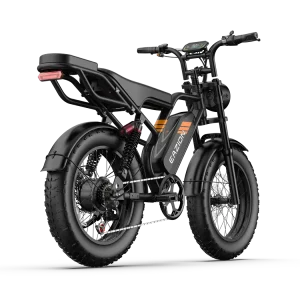
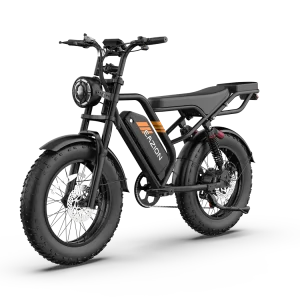
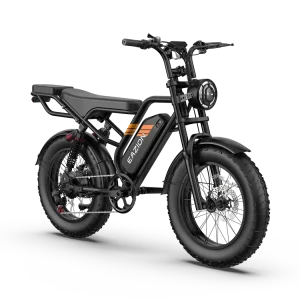


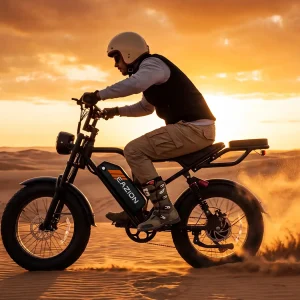
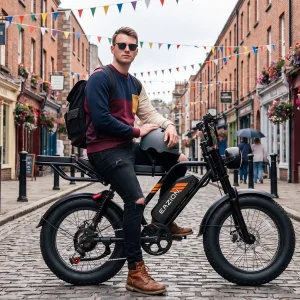
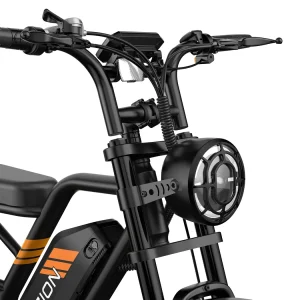
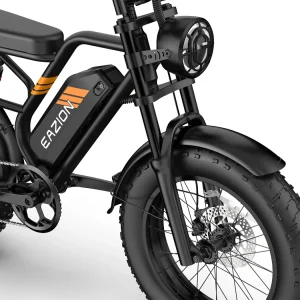
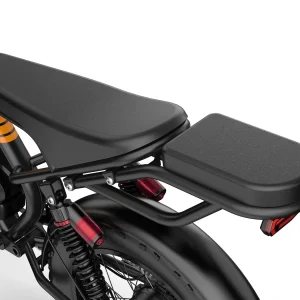
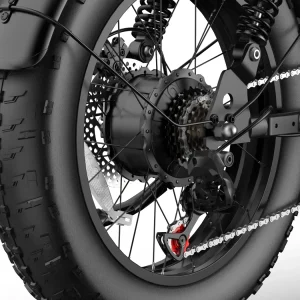
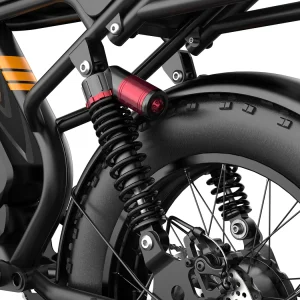
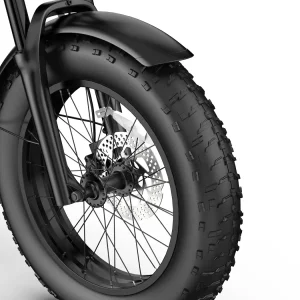
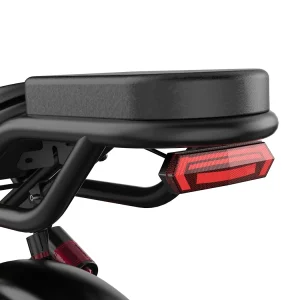
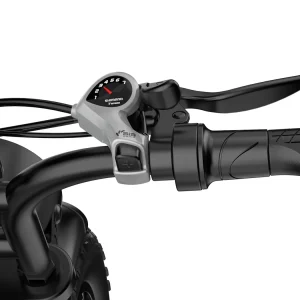
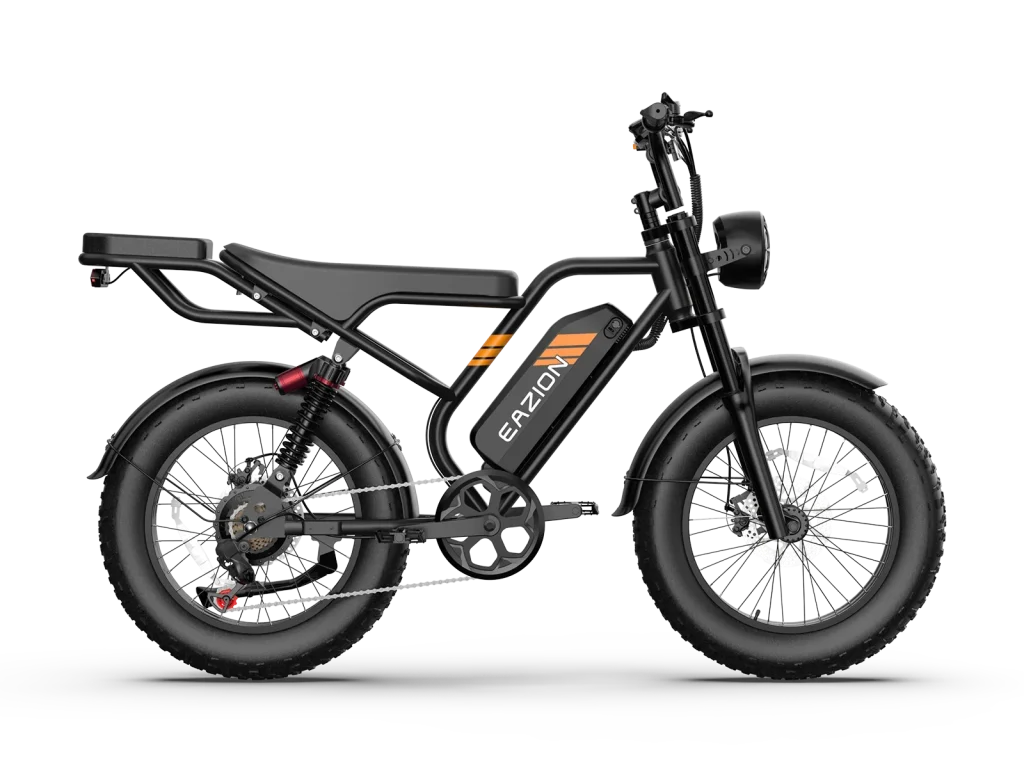
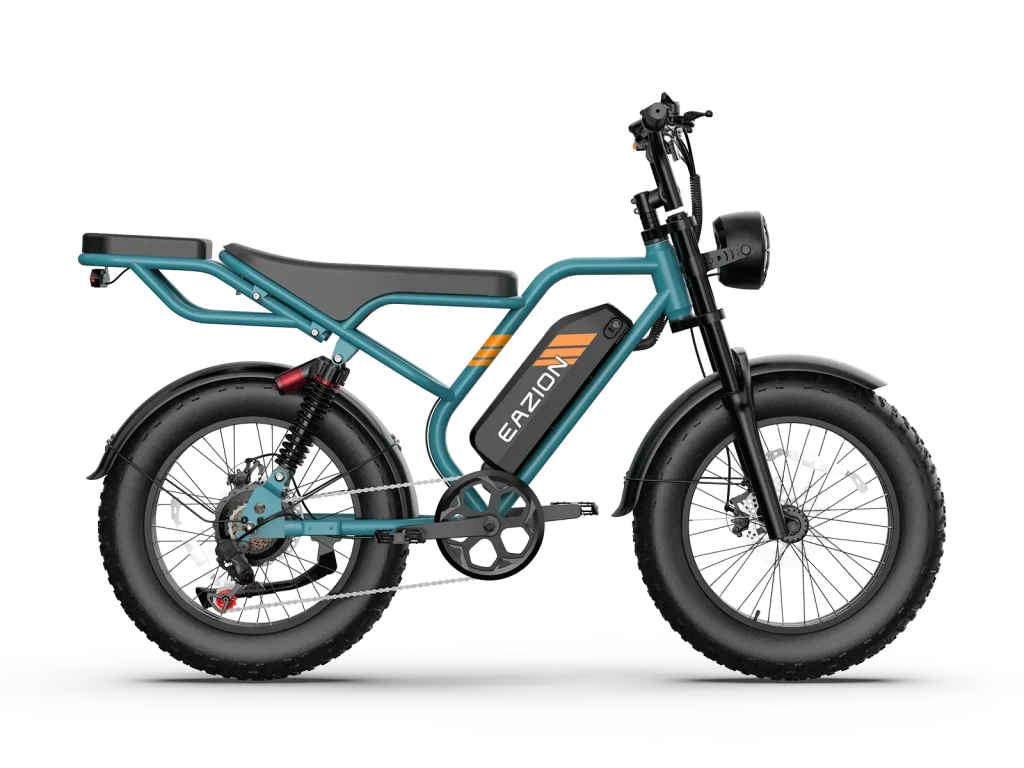
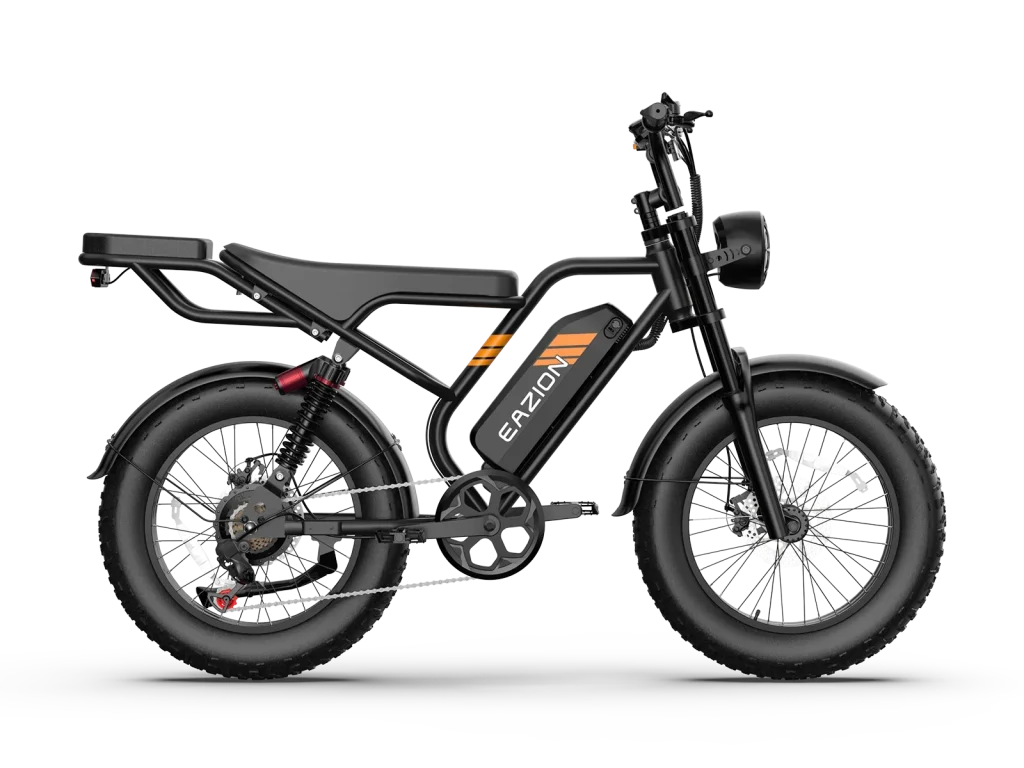
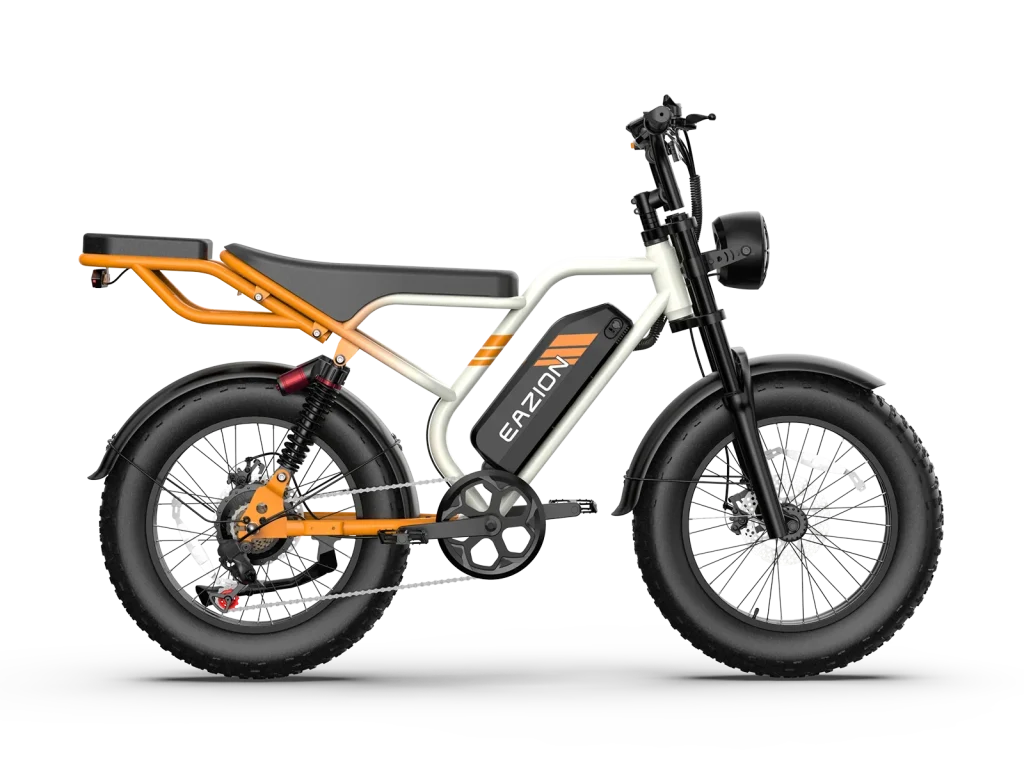
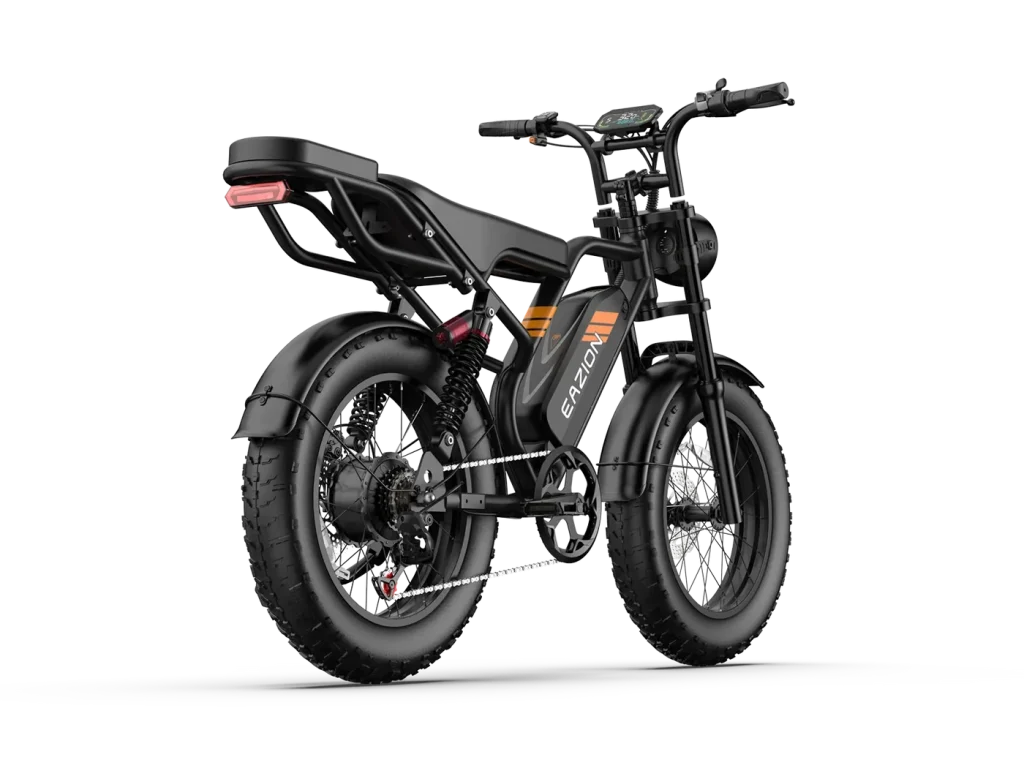
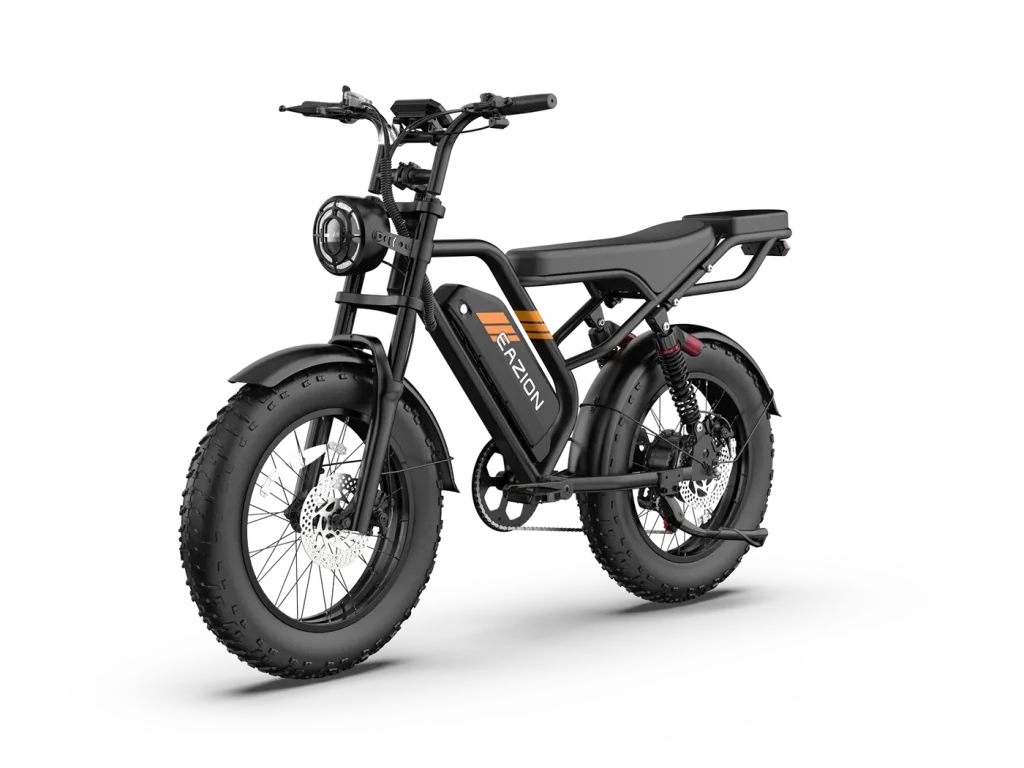
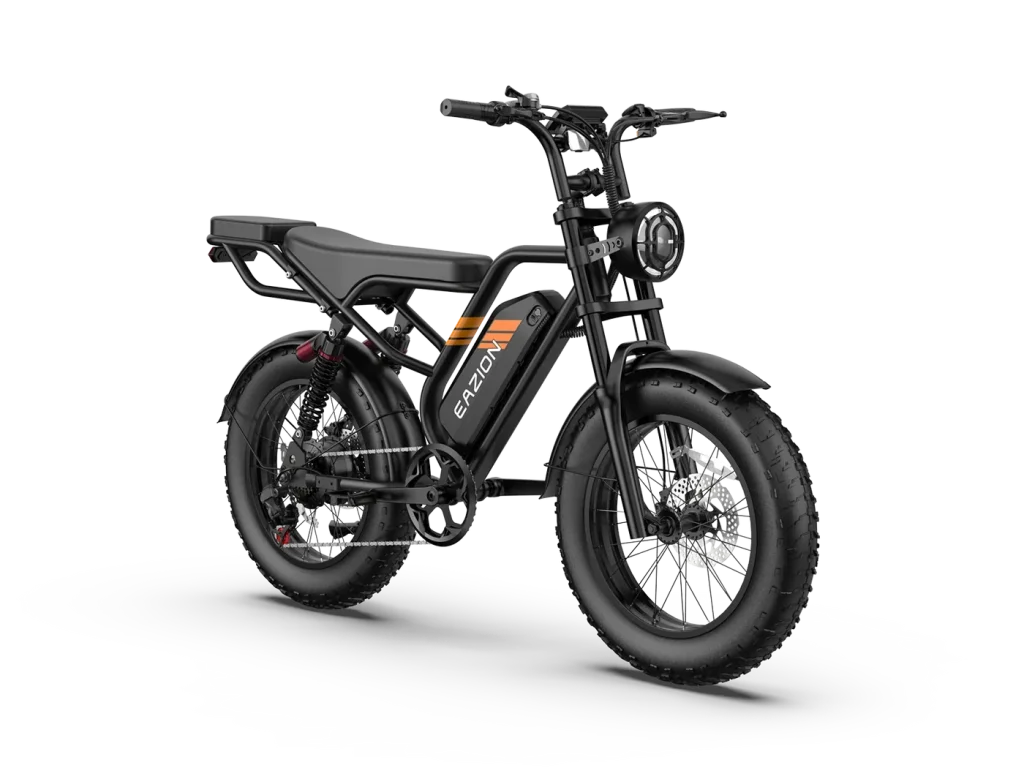

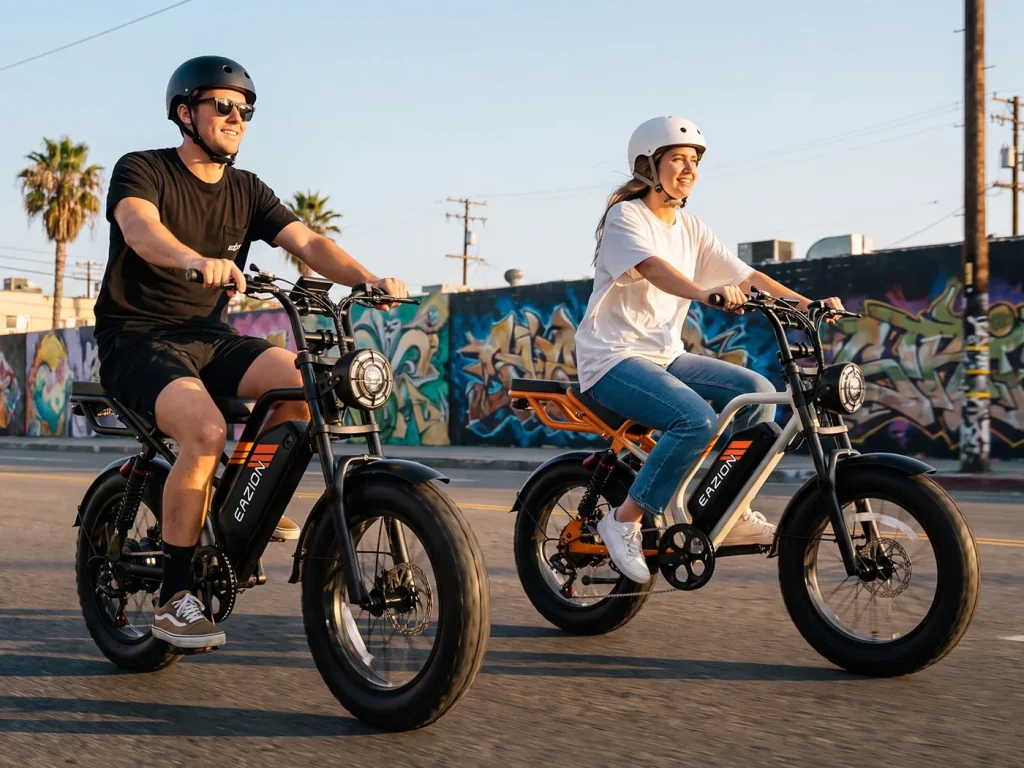
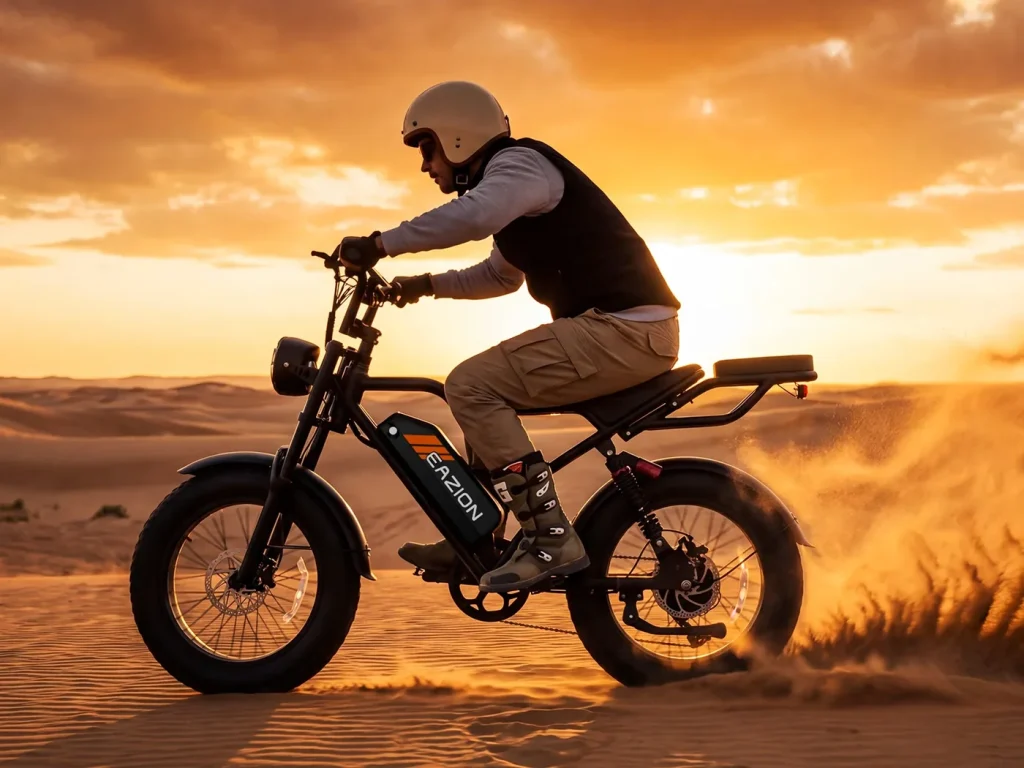
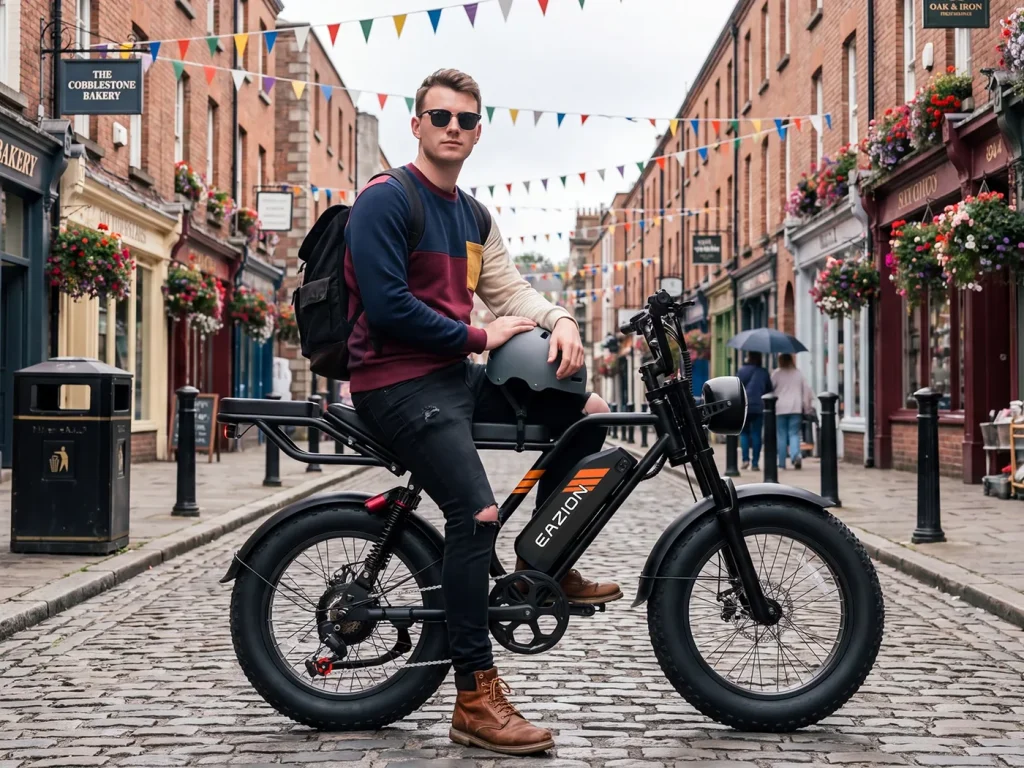
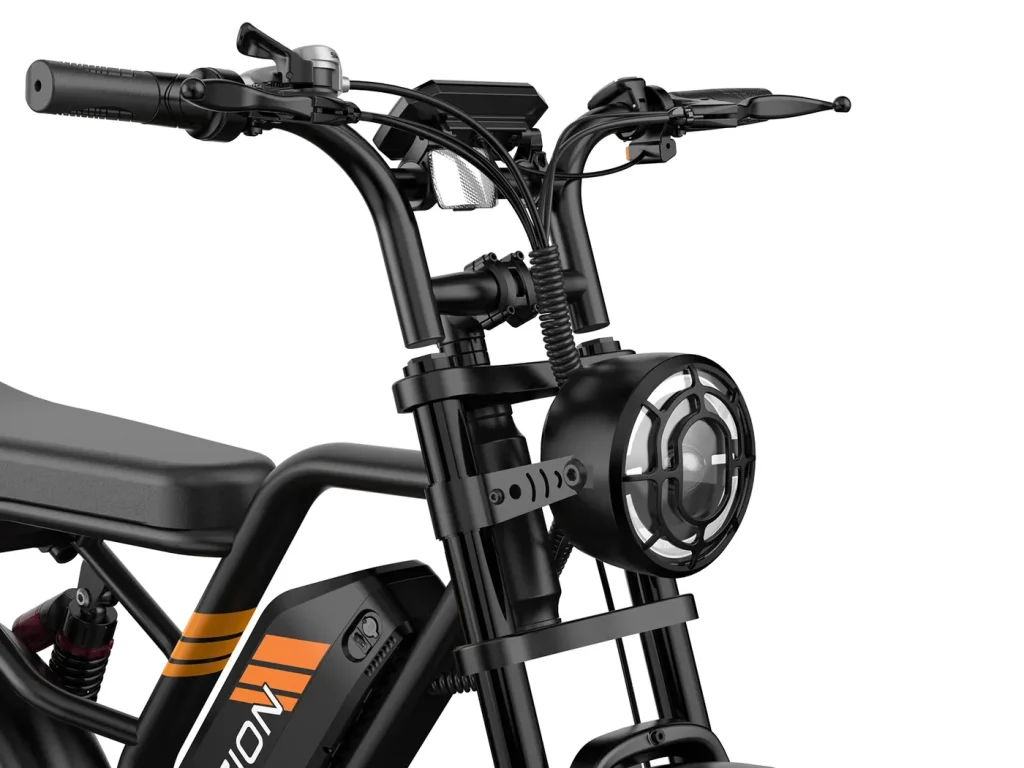
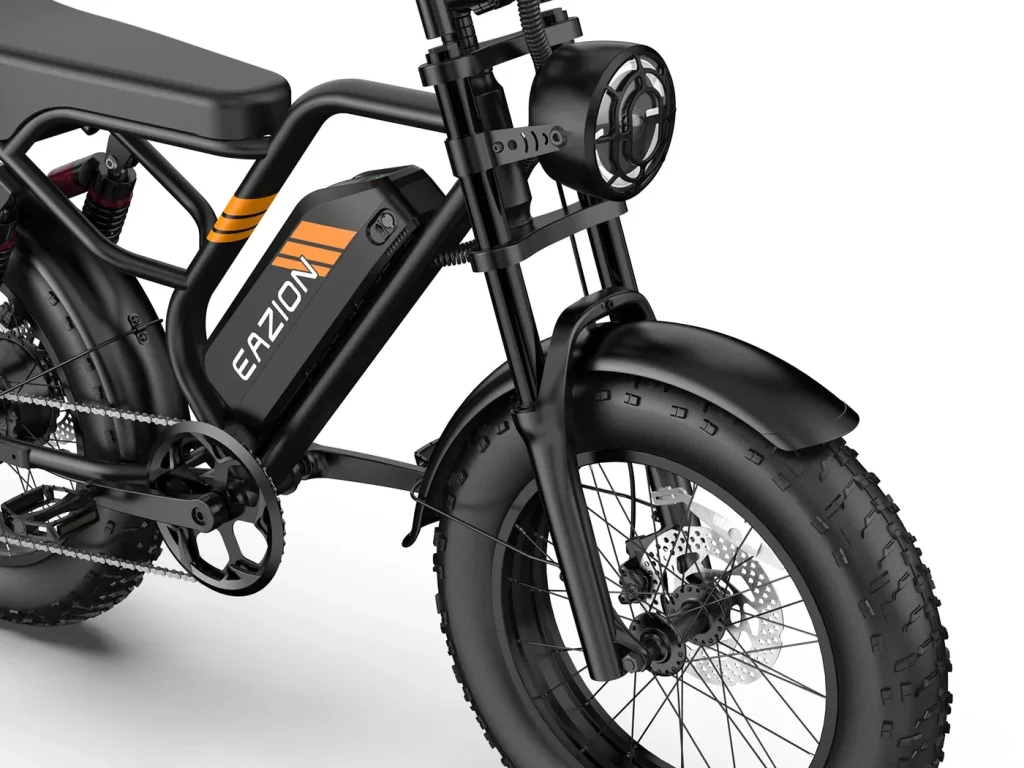
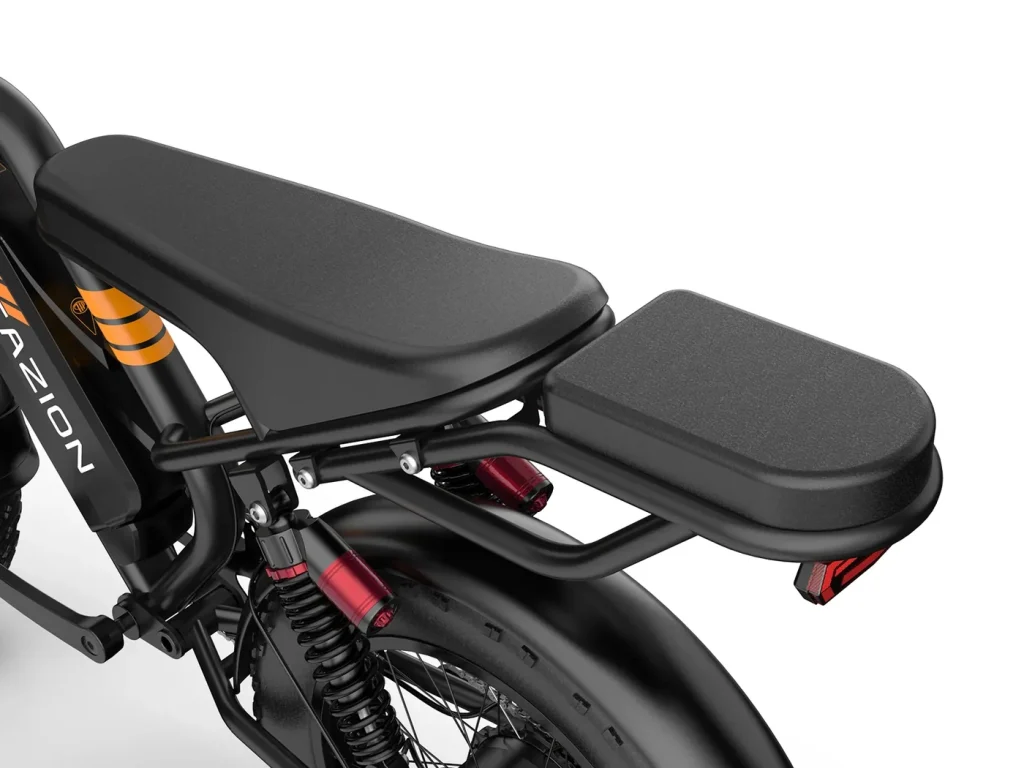
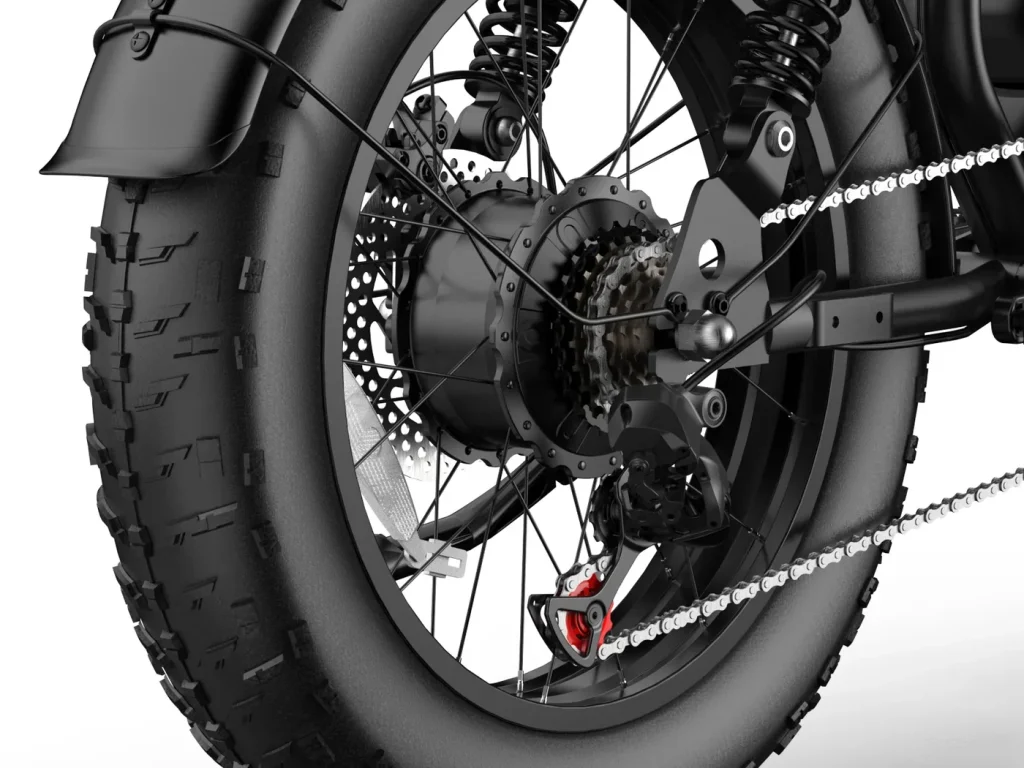
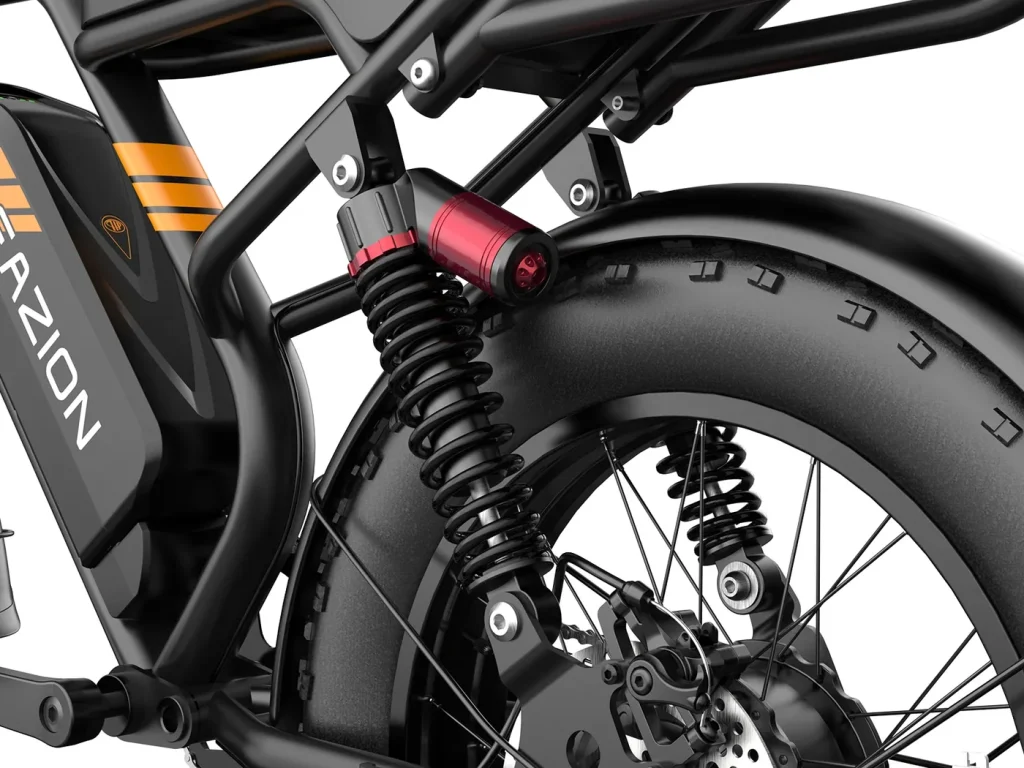
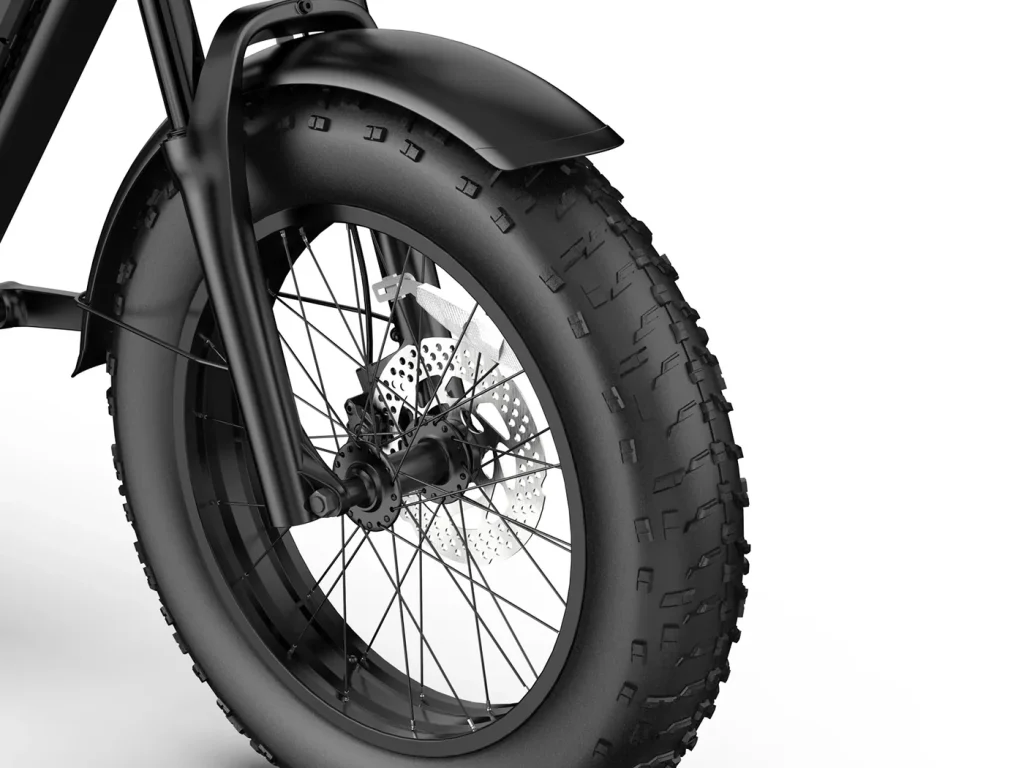
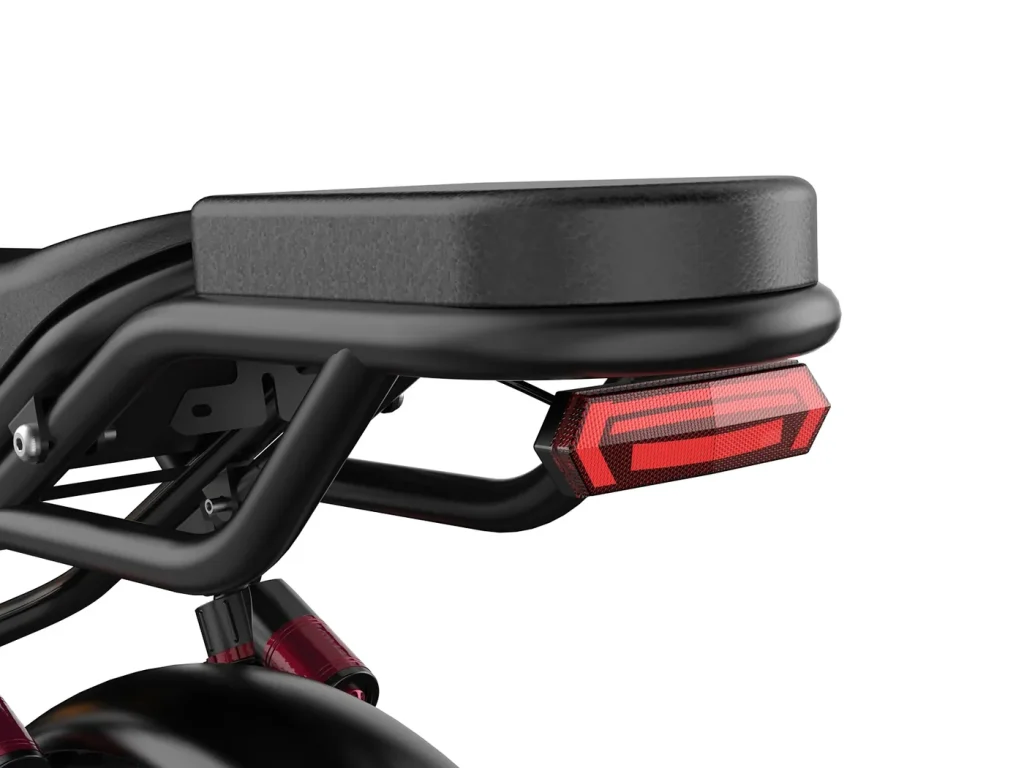
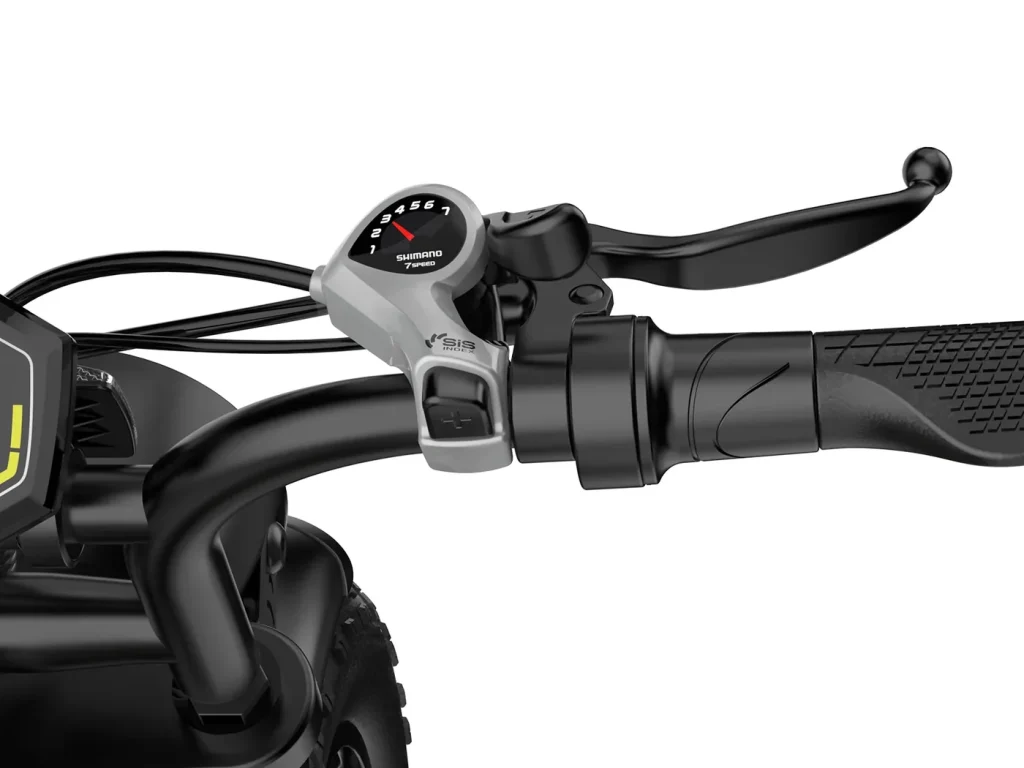
Eazion K9, Moped-style electric bike, fat tires
A moped-style electric bike with fat tires, designed for comfortable city cruising and everyday rides.